



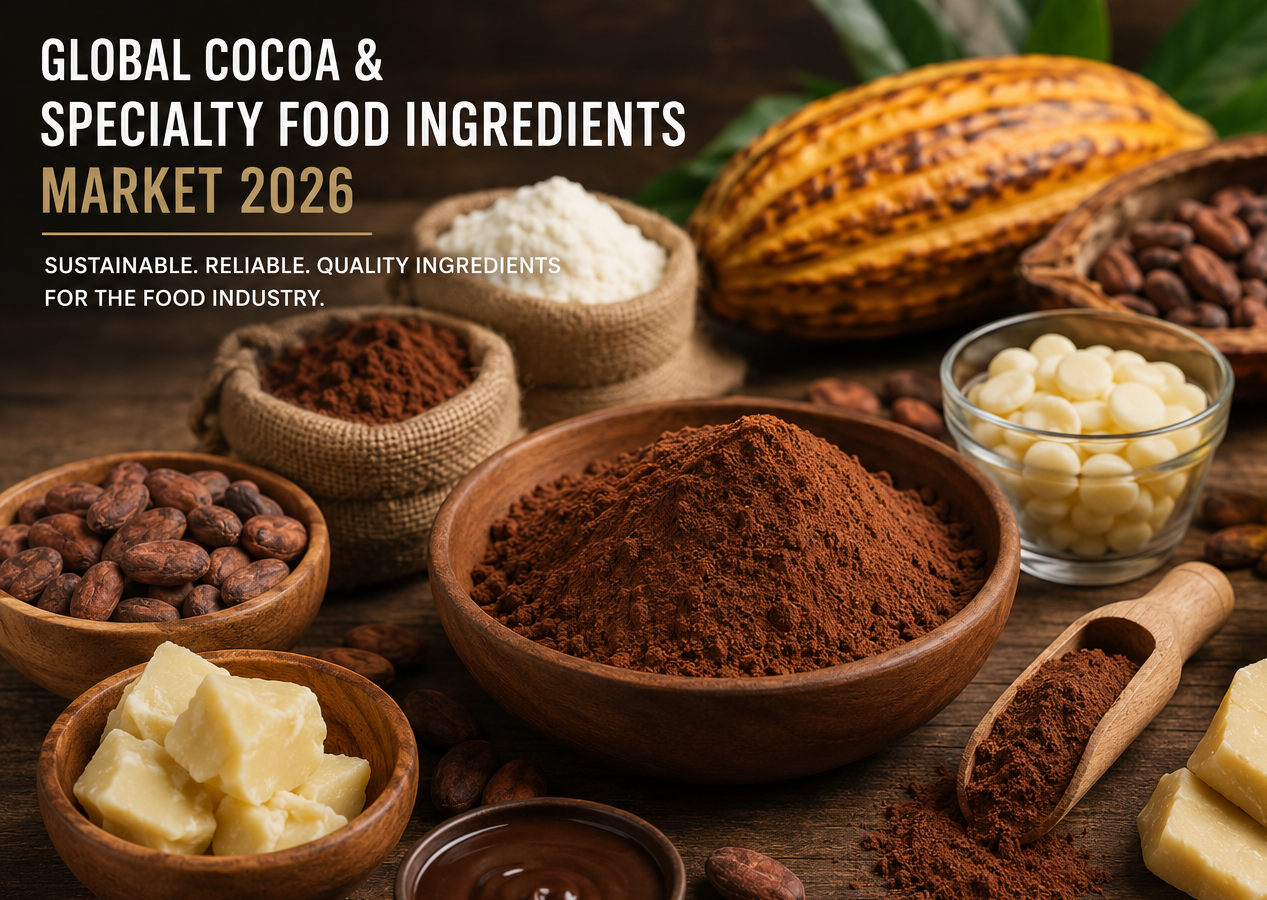
Global Cocoa & Specialty Food Ingredients Market Report 2026
Cocoa Powder, Specialty Fats, Functional Ingredients & Sustainable Sourcing
The global cocoa and specialty food ingredients market is undergoing a major transformation in 2026. Rising climate pressure, supply chain volatility, sustainability regulations, and growing demand for processed foods are reshaping ingredient sourcing strategies worldwide.
For manufacturers in confectionery, bakery, dairy, beverage, processed food, and nutritional sectors, sourcing ingredients is no longer only about pricing. It has become a strategic operational requirement focused on quality consistency, supply reliability, sustainability, and scalable manufacturing performance.
Industrial food production increasingly depends on high-performance ingredient systems including cocoa powder, cocoa butter, specialty fats, palm-derived oils, emulsifiers, stabilizers, sweeteners, dairy proteins, and starch solutions.

Global Agricultural and Food System Dynamics
Agriculture remains the foundation of the global food ingredients industry. Cocoa cultivation, oilseed farming, starch processing, and dairy production are heavily influenced by climate conditions, labor availability, land utilization, and international trade flows.
In 2026, food manufacturers continue facing several major challenges:
- Raw material price volatility
- Supply chain disruptions and shipping uncertainty
- Stricter environmental regulations
- Demand for consistent ingredient specifications
- Pressure for sustainable sourcing transparency
Climate-related disruptions in West African cocoa-producing regions continue to impact global cocoa supply and pricing. At the same time, processed food demand is expanding rapidly across Asia, the Middle East, and Africa.
As a result, specialty food ingredients are increasingly considered production-critical components that directly affect manufacturing continuity, product stability, and operational efficiency.
Cocoa Industry Overview in 2026
Cocoa remains one of the most strategically important agricultural commodities globally due to its essential role in chocolate, bakery, confectionery, beverage, and dessert manufacturing.
The cocoa processing chain includes:
- Cocoa beans
- Cocoa liquor (cocoa mass)
- Cocoa butter
- Cocoa powder
Each stage of cocoa processing directly influences manufacturing costs, product quality, texture, flavor, and shelf stability.
In 2026, the cocoa market continues experiencing supply pressure due to weather instability, crop disease, sustainability compliance costs, and limited production concentration in countries such as Côte d’Ivoire and Ghana.
Manufacturers increasingly prioritize:
- Reliable cocoa suppliers
- Consistent quality specifications
- Traceable sourcing systems
- Stable shipment performance
- Long-term sourcing partnerships

Cocoa Powder Market Trends
Cocoa powder remains one of the most widely used ingredients in industrial food manufacturing. Both natural cocoa powder and alkalized cocoa powder are used across bakery, dairy, beverage, confectionery, breakfast cereals, and nutritional products.
Natural Cocoa Powder
Natural cocoa powder provides lighter color profiles and stronger cocoa acidity, making it ideal for baked goods and formulations requiring intense cocoa flavor notes.
Alkalized Cocoa Powder
Alkalized (Dutch-processed) cocoa powder offers darker color, smoother taste profiles, and improved dispersibility, especially important for beverage systems and instant drink mixes.
Manufacturers increasingly require cocoa powder with:
- Stable color consistency
- Controlled fat content
- Reliable microbiological standards
- Predictable processing behavior
- High dispersibility performance
Global demand for premium chocolate products, protein-enriched snacks, fortified foods, and indulgent bakery products continues driving cocoa powder market growth.
Cocoa Butter and Specialty Fat Systems
Cocoa butter remains essential for premium chocolate manufacturing because of its unique melting profile, crystallization properties, and mouthfeel characteristics.
However, rising cocoa prices and supply limitations have accelerated the adoption of alternative specialty fat systems such as:
- Cocoa Butter Substitutes (CBS)
- Cocoa Butter Equivalents (CBE)
- Cocoa Butter Replacers (CBR)
Palm-derived oils continue playing a critical role in specialty fat manufacturing, including:
- RBD palm oil
- RBD palm olein
- Palm kernel oil
- Coconut oil
- Hydrogenated vegetable fats
- Interesterified fats
These ingredient systems provide:
- Improved thermal stability
- Oxidation resistance
- Extended shelf life
- Texture optimization
- Processing consistency

Functional Ingredients in Industrial Food Manufacturing
Functional ingredients are essential for ensuring scalability, processing efficiency, and product consistency in industrial food production.
Emulsifiers
Emulsifiers such as lecithin improve fat dispersion, viscosity control, and flow properties in chocolate, dairy, bakery, and beverage applications.
Stabilizers and Hydrocolloids
Guar gum and xanthan gum are widely used for viscosity management, texture enhancement, and phase stability in sauces, fillings, beverages, and dairy products.
Starch Systems
Native and modified starches support thickening, binding, and moisture retention in confectionery, bakery, frozen foods, and ready meals.
Sweetener Systems
Glucose syrup, fructose, and sorbitol contribute to sweetness balance, humectancy, shelf-life extension, and texture optimization in processed food applications.
Dairy Ingredients and Nutritional Applications
Dairy ingredients continue playing a strategic role in food manufacturing due to their functional and nutritional value.
Key dairy-based ingredients include:
- Milk powders
- Whey proteins
- Dairy creamers
- Dairy fat systems
Growing demand for protein-enriched foods is driven by sports nutrition trends, healthy lifestyle awareness, and aging populations.
Food manufacturers increasingly combine dairy proteins with cocoa systems and functional ingredients to create:
- Nutritional beverages
- Protein snacks
- Meal replacement products
- Fortified desserts
Sustainability and Responsible Sourcing
Sustainability has become a core requirement in the global food ingredients industry. Manufacturers and international brands increasingly demand transparent and environmentally responsible sourcing practices.
Key sustainability priorities include:
- Traceable supply chains
- Reduced environmental impact
- Responsible agricultural sourcing
- Improved farmer livelihoods
- Water and energy efficiency
- Waste reduction strategies
In both cocoa and palm oil sectors, sustainability compliance is now essential for long-term market access and international trade partnerships.
Supply Chain Resilience and Market Challenges
Global ingredient supply chains remain exposed to geopolitical instability, logistics disruptions, inflationary pressure, and climate-related production risks.
Manufacturers are responding by:
- Diversifying sourcing regions
- Increasing inventory buffers
- Standardizing ingredient specifications
- Building long-term supplier relationships
Suppliers capable of maintaining reliable logistics, stable quality standards, and responsive communication are increasingly viewed as strategic partners rather than transactional vendors.
Market Outlook for 2026 and Beyond
Despite ongoing global challenges, the cocoa and specialty food ingredients market is expected to continue growing due to:
- Rising processed food consumption
- Expansion of premium confectionery markets
- Growth in functional and nutritional foods
- Increased focus on food security
- Demand for sustainable ingredient sourcing
- Innovation in specialty fats and functional ingredients
As food manufacturing becomes increasingly complex, ingredient suppliers will continue playing a central role in ensuring operational resilience, production efficiency, and product quality consistency.
Palmart Food Ingredient Solutions
Palmart, through its Palier Food Ingredients Division, supports manufacturers across confectionery, bakery, dairy, beverage, processed food, pharmaceutical, nutritional supplement, savory, snack, sauce, canned food, and health & beauty sectors.
The company supplies industrial-grade food ingredients aligned with modern manufacturing requirements and international sourcing standards.
Product Portfolio
Explore Palmart product portfolio
Why Work with Palmart?
- International food ingredient sourcing expertise
- Consistent quality specifications
- Competitive global supply capabilities
- Reliable export and logistics support
- Sustainable sourcing strategies
- Extensive industrial food manufacturing experience
Contact Palmart
Contact Palmart today to request:
- Technical specifications
- Pricing information
- Product catalogs
- Customized sourcing solutions
- Bulk ingredient supply support
Palmart delivers reliable ingredient sourcing solutions for modern industrial food manufacturing operations worldwide.
Request Technical Consultation / Order Food Ingredients
Looking for reliable industrial food ingredients supply solutions for your production line?
Our team supports B2B manufacturers in cocoa, dairy, oil & fat systems, sweeteners, and functional additives.
Contact us today to receive technical specifications, pricing, and supply options.