




It is the nightmare scenario for any confectionery production line: The biscuits look perfect coming out of the cooling tunnel, but 24 hours later, the chocolate coating displays micro-fractures. Or worse, the coating flakes off entirely when the consumer takes the first bite.
You’ve checked your tempering temperature. You’ve calibrated the cooling tunnel speed. But have you checked your cocoa powder?
Many manufacturers assume cocoa powder is just for flavor and color. In reality, the fat content (cocoa butter percentage) of your powder is a structural ingredient that dictates the elasticity of your final coating.
Here is why your “standard” powder might be causing your premium product to crack.
The Physics of Enrobing: It’s About Flexibility
When you enrobe a sponge cake, marshmallow, or ice cream bar, you are essentially wrapping a flexible core in a rigid shell. As the core expands or contracts (due to moisture migration, freezing, or ambient temperature changes), the shell must move with it.
If your coating is too rigid, it snaps. If it has elasticity, it stretches.
That elasticity comes almost entirely from the fat matrix.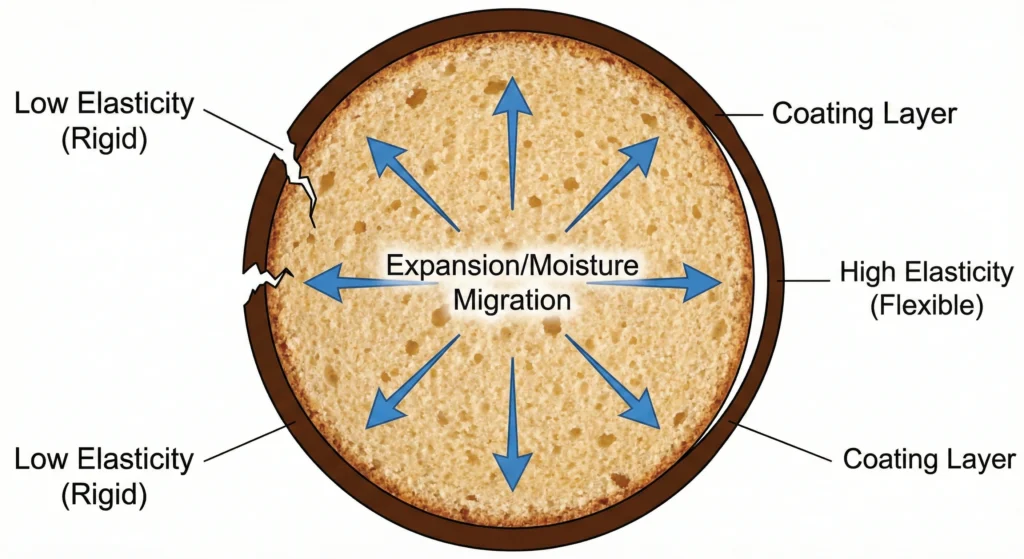
The Trap: 10/12 vs. 20/22
Most industrial buyers default to Standard 10/12 Natural or Alkalized Cocoa Powder. It is cost-effective and provides great color.
-
10/12 Powder: Contains 10-12% cocoa butter. The remaining ~90% is solid cocoa fiber.
-
20/22 Powder: Contains 20-22% cocoa butter. The remaining ~80% is solid cocoa fiber.
That extra 10% of fat isn’t just “richness”; it is a plasticizer.
How Low-Fat Powder Breaks Your Coating
When you use a low-fat (10/12) powder in a compound coating (especially those using vegetable fats like CBS or CBR), you are introducing a high volume of dry cocoa solids.
-
Oil Absorption: The dry cocoa fibers absorb the free fat from your recipe (your expensive cocoa butter substitutes).
-
Viscosity Spike: This absorption increases the viscosity (thickness) of the liquid chocolate, forcing you to add more oil just to get it through the enrober curtain.
-
The “Brick Wall” Effect: Once crystallized, those dry fibers create a dense, rigid structure rather than a flexible web. The coating becomes hard, brittle, and prone to cracking under minor stress.
The High-Fat Advantage: A 20/22 powder carries its own lubrication. It integrates smoother into the fat phase, creating a coating that is more “supple.” It can withstand the slight expansion of a sponge cake or the thermal shock of an ice cream bar without fracturing.

The “Squeeze Test” (Try This in the Lab)
You don’t need a rheometer to see the difference. Try this simple bench test:
-
Make two small batches of compound coating: one with PALMART’s Standard 10/12 and one with PALMART’s High-Fat 20/22.
-
Dip a flexible plastic spatula into each and let them set hard.
-
Bend the spatula 45 degrees.
The 10/12 coating will likely snap cleanly and immediately. The 20/22 coating will often bend slightly before breaking. That “bend” is exactly what saves your product during shipping and shelf-life.
Which Powder Should You Use?
-
Use 10/12 (Standard) for: Hard biscuits, cookies, and products where a “snap” is desired and the core is rigid.
-
Use 20/22 (High Fat) for: Soft cakes, marshmallows, Swiss rolls, and premium ice cream coatings where the core is soft or flexible.
Stop the Cracks Before They Start
If you are battling texture failures, don’t just adjust your cooling tunnel. Look at your formulation. A switch to high-fat cocoa powder might cost slightly more per kilogram, but it is cheaper than a rejected batch of cracked product.
Need to test the elasticity yourself? Contact our team today to get a sample of PALIER’S Alkalized Cocoa. Let’s find the right flex for your formula.